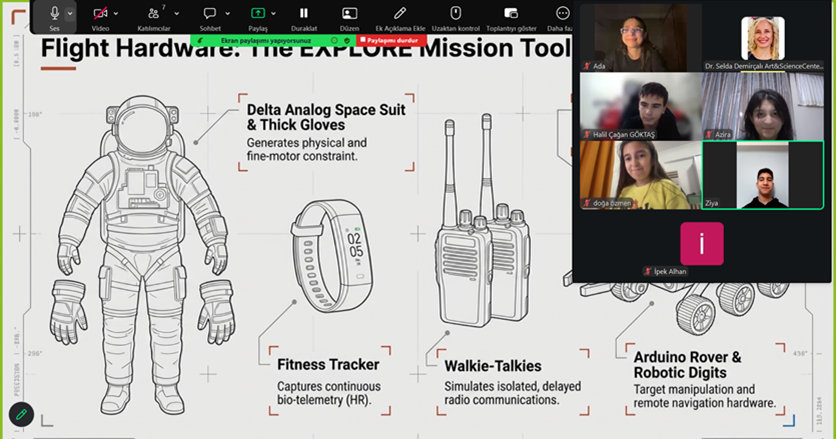
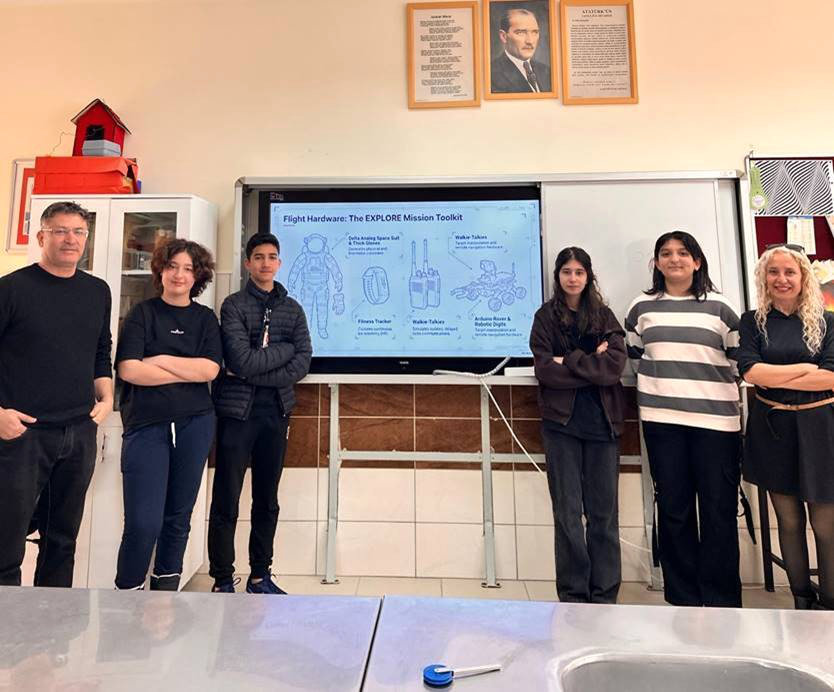
The winning entry for the EXPLORE Experiment Design Challenge was submitted by the Antalya Art & Science Center (BİLSEM), Türkiye. The main criteria for selection were that the experiment could
- introduce new aspects not already covered in the mission while using the tools provided in the physical and virtual toolkits
- be fully feasible within operational constraints (e.g. limited EVA time, weather conditions, etc)
- be implemented robustly in a field environment
- demonstrate scientific rigour through the clarity of the research question and the validity of the methodology.
Students Görkem, Ada and Halil and their teachers have been taking a deep interest in space sciences. Their proposed experiment, “Adaptive Human-Machine Interfaces: Assessing Astronaut Ergonomics, Reflexes, and Rover Teleoperation under Simulated Mars Conditions” fitted the criteria well and was duly integrated into the EXPLORE-2 mission plan. The experiment was carried out after an extensive exchange with the mission support centre (MSC) in Monsaraz on 18 April 2026 and was eagerly followed by BİLSEM through a live link via the MSC.
Their lead teacher Dr Selda Demirçalı said, “Our students have been taking their current EXPLORE preparation very seriously. They are actively training for their roles at the MSC. We have been practising the NATO Phonetic Alphabet and radio etiquette (using standard phrases like “Affirmative” and “Copy”) to simulate the communication delay for the rover teleoperation. They are also familiarizing themselves with the procedures for tracking the astronauts’ life sign measurements (like heart rate) and reflexes.”